



Hooks and the Host
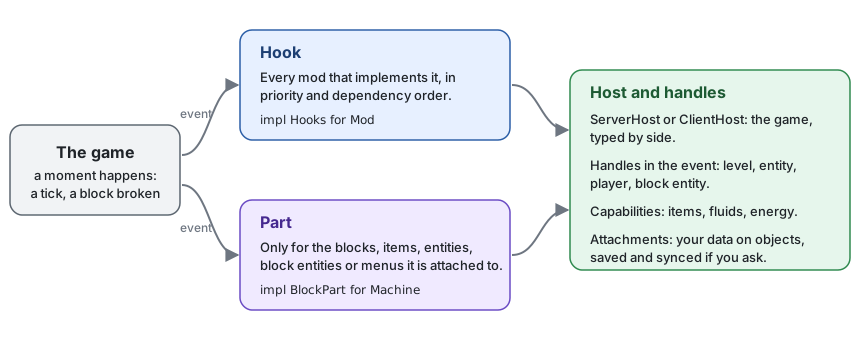
A hook is one moment in the game: a tick, a block broken, a player joining. Your mod implements the hooks it needs as methods of mod_api::Hooks, and the game calls each subscribed mod with the moment's event and a host, its typed view of the game. A moment that belongs to one object is a method of a Part instead, called only for the objects your mod attached it to.
From Sunrise's modding bookead8a1e
On this page
Dispatch
Mods run in order of their listener priority, highest first, then in dependency order: a mod after the mods it depends on. When a mod cancels an event, the mods after it are skipped, unless they receive cancelled events (Listener priority and cancellation).
What a hook's return value means depends on its kind:
- Listen hooks are notices: every subscribed mod is called.
- Cancellable hooks return
Flow:Flow::Cancelstops the game's action and skips later mods. - Replacement hooks return an
Option: the first mod to answerSomewins. - Collection hooks call every mod, each adding to a list in the event.
A hook with no receiver gets no Host.
Player tick hooks
player_tick_pre and player_tick_post bracket the player's body tick on both logical sides. On the server, neither hook fires for a spectator whose bounds touch an unloaded chunk: that player's body tick is skipped. Connection and level upkeep and outgoing state updates still run. The server resolves whether the body runs before the pre hook; a listener changing the player's position does not change that decision for the current tick.
Explosion membership
explosion_detonate version 2 exposes mutable blocks and entities lists before an explosion applies its effects. The initial entity query excludes the exploding source. Remove entries to spare them, or add live handles to make them eligible; additions still obey normal distance, exposure and immunity checks. Stale or invalid handles are dropped and repeated IDs are visited once. A mod can explicitly add a valid source handle back; per-kind immunity still applies.
The final list controls membership, not global effect ordering. Its order is used for ordinary storage targets. Crystals/dragon and players retain their earlier separate passes, while frames and other decorations run last in storage order. Block positions are shuffled before destruction. An empty entity list spares direct entity effects, not indirect consequences of destroying support blocks. With no subscriber the game does not build a target list.
Saving and game events
To save from inside a hook, use level.request_save(host) so the save runs at the next settled start-of-tick boundary. A synchronous save-all while an entity pass or held-out row is borrowed fails with vanilla's commands.save.failed feedback and a failed command result, without saving.
To emit a vibration-producing game event, use level.game_event(host, event, at, context). GameEventContext carries an optional source entity and affected block state; see game events with context for listener semantics and refusals.
Listener priority and cancellation
#[listener] on a hook method sets both, as NeoForge's EventPriority and receiveCanceled do. Two mods, each its own crate:
#[mod_api::sunrise_mod]
impl Hooks for Protection {
    // Runs before mods at the default priority, 0; higher runs first.
    #[listener(priority = 100)]
    fn break_block(&self, host: &mut dyn ServerHost, event: &mut BreakBlockEvent<'_>) -> Flow {
        if self.protected(host, event.pos) { Flow::Cancel } else { Flow::Continue }
    }
}

#[mod_api::sunrise_mod]
impl Hooks for Override {
    // Receives cancelled events and may clear cancellation.
    #[listener(priority = -100, receive_cancelled)]
    fn break_block(&self, host: &mut dyn ServerHost, event: &mut BreakBlockEvent<'_>) -> Flow {
        if event.cancelled && self.allowed(host, event.pos) {
            event.cancelled = false;
        }
        Flow::Continue
    }
}
priority is an i32, 0 when omitted; mods of equal priority keep dependency order, as [[inject]] priorities do (Injections). Each hook's order is fixed once, when the mods are installed. Every cancellable hook's event has a cancelled field: a mod without receive_cancelled always sees false, since it is not called once the event is cancelled. A mod that receives cancelled events and sets it back to false lets the game's behaviour run, and the mods after it are told again. An event the game hands over already cancelled reaches only mods that receive cancelled events. receive_cancelled on a hook without a cancel does not compile, and #[listener] is for a mod's hooks only: a part is called for its own thing, in no order.
Native and wasm mods use the same listener ordering and cancellation rules. Wasm subscription records carry the hook name, signed priority, and receive-cancelled flag through the shared-memory Wire boundary at load time. The event's cancelled field crosses with its other writable fields.
Events and shared state
Each hook method takes its host, where it has one, and one event:
fn living_incoming_damage(
    &self,
    _level: &mut dyn HitHost,
    event: &mut LivingIncomingDamageEvent<'_>,
) -> Flow {
    if event.kind == "minecraft:pig" {
        let halved = event.container.new_damage() * 0.5;
        event.container.set_new_damage(halved);
    }
    Flow::Continue
}
For incoming damage, event.weapon is the direct entity's weapon, including a projectile's saved firing weapon. event.causing_weapon is instead the causing living entity's current main-hand weapon (DamageSource.getEntity().getWeaponItem()): an off-hand crossbow shot can name the saved crossbow in weapon and the shooter's main-hand sword in causing_weapon. An absent, unknown or non-living cause has no causing_weapon.
The event is a generated struct named after the catalog hook, in CamelCase plus Event, with the hook point's arguments as public fields: values as values and borrowed ones as references (event.kind). A number or bool a mod may change is a plain field, written back once every mod has run, even after a Cancel; anything else a mod may change, a game struct or a list, is a &mut field. A cancellation or replacement is the return value; a collection hook's list is a field (event.lines). One event goes through every mod, so each sees the changes before it. To exercise dispatch behavior, use the hook's dispatch function (Testing a mod).
The generator validates edited stack-list outputs inside each listener's owning scope. A refused stack output retains the immediately preceding accepted value, not the event's initial value. Scalar outputs and cancellation still commit; later listeners see the accepted stacks and run independently under the usual cancellation rules. Each refused output logs one warning naming the mod, hook, output and conversion error. This policy is identical for native and wasm listeners.
Hook methods take &self and require Send + Sync. The process-wide mod list is installed once, like mixin module statics. One mod instance serves both the window's game and the server-thread game. A hook can also fire again inside the same mod: for example, LevelRef::set_block fires block_changed. Mods keep mutable state with interior mutability so these calls can share the instance safely. Data-load hooks can run on any loading thread; item default changes must be identical on every side.
Hooks contains global hooks. Scoped hooks belong to BlockPart, BlockEntityPart, ItemPart, MenuPart or FluidPart and run for the registered object.
Level hosts
Level hooks use access-specific hosts rather than Host. LevelHost provides block_state through LevelAccess::block_state, client-side detection and state_with_property. state_string(state) serializes the full name and properties, or returns None for an unknown state; min_y() and height() read the level's build range. It also reads light and loaded state, through the game's own queries: brightness(LightLayer::Block | Sky, pos) (getBrightness, the stored 0 to 15), raw_brightness(pos, sky_darken) (getRawBrightness, which CropBlock.randomTick asks with 0) and is_loaded(pos) (Level.isLoaded: inside the build height and in a loaded chunk), is_raining_at(pos) (Level.isRainingAt, false where pos is not loaded) and enabled_features() (LevelReader.enabledFeatures, a borrowed FeatureFlags<'_>). These queries do not allocate. None of them loads a chunk. Light above the build height reads as full sky and below it as none, and a chunk that isn't loaded reads as the game's query does (full sky, no block light), so check is_loaded first. It also answers tag and fluid questions without a Host: block_in_tag(block_key, tag), fluid_state(pos) (getFluidState, None where the block read is), state_fluid_state(state) and fluid_in_tag(fluid_name, tag). Fluid reads return FluidState with a FluidKey, amount, falling flag and engine-derived source flag; is_empty() and is_source() report those states without a registry lookup. block_state_id(name) parses a block and properties, and block_state_default(block) gives a block's default state, as on Host; both return None for invalid input or unavailable context. Tag reads are None when authoritative tags are unavailable, including on a client before its server's tags are applied. For item membership and member lists, use Host::tags(): resolve a TagKey with Tags::key, then call Tags::is_in_tag, Tags::items or Tags::fluids. Membership reads return None on clients until server-sent tags are applied, which tags_updated announces; they never substitute local resource-pack tags. default_components_bound precedes tags_updated after item defaults are published and readable. Both notices carry TagsUpdateCause: ServerDataLoad { reload } for the server's initial data load or reload, and ClientPacketReceived { integrated_server } for a client's applied tags. should_update_static_data() is true on the server and a remote client, but false on an integrated client, whose server already updated the shared static data. Installing client tags announces the bound defaults; it does not rebind those defaults.
Redstone and shape reads on LevelHost, for placement and survival: signal(pos, direction) (SignalGetter.getSignal), direct_signal, direct_signal_to, best_neighbor_signal(pos), has_neighbor_signal(pos) (what a lamp's or a door's placement reads) and collision_shape(pos) (the block's collision boxes at pos, block-local, a block entity's published shape included, empty for no collision, None for an unloaded position). The signal reads are the game's own, block_signal and should_check_weak_power listeners included, and are the same ones LevelRef and the tick hooks give. state_for_placement and can_survive receive a level that answers them, so a block can place or survive by what powers it or what shape sits beside it. The levels of state_for_placement, can_survive and the level tick and shape-update hooks answer all of them; the levels other callbacks get (a damage hit's, a part's read view) may return None for any of them, signal reads and collision_shape alike. A signal read never asks state_for_placement or can_survive, so it cannot re-enter the hook it was read in. LevelTicksHost's signal reads moved here and now return Option.
LevelHost has no random access: a draw from a read-only hook inside a level write would shift the level's random sequence away from vanilla's order. A hook that may draw is given a LevelRandomHost. LevelRandomHost provides vanilla's Level.random so mod draws come in vanilla's order. LevelTicksHost adds scheduling through schedule_block_tick and schedule_fluid_tick, while LevelWriteHost adds random access, set_block, set_block_property, play_sound and send_particles and level_event (levelEvent, queued in order with the write's own events). A damage hit's listeners (living_incoming_damage, living_damage_pre, living_damage_post, living_shield_block, living_use_totem) are given a HitHost: a LevelRandomHost that also plays level sounds and draws from an entity's own random, and writes no block. host.play_sound_at(sound, at, source, volume, pitch) is Level.playSound(null, x, y, z, ...) and host.play_sound_from(entity, ...) is Level.playSound(null, entity, ...): every player in range hears it, and a cancelled hit still plays what was queued. The seed is drawn at the call from the level's sound-seed stream, not from the level's random. entity.next_float(host), next_double, next_bool and next_int(host, bound) draw from the entity's actual random stream, in listener order. A hit lends its attacker where the game applies a melee hit (the attacking player or mob, for player → mob, mob → mob and mob → player) and no entity at any other damage site (environment, projectiles, explosions, potions and the like); the attacking mob's own random is the one its AI draws from, and a hit built inside a mob's own tick lends none. Any other entity, a stale handle, a client and an out-of-range bound answer None (false for a sound). Outside a write, a LevelRef plays level events, and their global form for every player on the server (Playing level events). set_block(pos, state, flags) is Level.setBlock on a whole state, as LevelRef::set_block takes it: it removes the old block's block entity and creates the new block's in the write (LevelChunk.setBlockState), runs the neighbour and shape updates flags ask for, and queues the write's level events in order. A mod block entity it creates starts with the data the block_entity hook gives, which is fired in the write and receives the level (LevelSide, read-only: vanilla's newBlockEntity gets no level), as the Host's native_set_block fires it. It returns true when the block changed, and false off an authoritative server, for a position that is not loaded or outside the build height, an invalid state, or the state the block already has. It never loads a chunk. The game owns the tick queue; mods do not pass it back to these helpers.
Drawing
Frame drawing through DrawContext, BlockEntityDrawContext and WorldDrawContext stays in mod_api. Raw GPU access is native-only, unstable and outside that API, in mod_render::render (sunrise-mod-render). Replace its frame functions with native HEAD mixins compiled against the prebuilt game. render_needs collects requests; world_drawn runs before the hand and HUD, and hand_drawn runs after the hand, on the render thread. Use API draw contexts for API-typed drawing.
After a hook that can change the world
A listener of a hook that gets a mutable host may remove, move or change objects. After such a hook returns without cancelling, the game does not use the list position or the state it worked out before the hook. It finds the object again by its entity id, checks the facts the action was decided on, and abandons the action if the object is gone or a fact changed; it never works the action out again. The hook still fires at its usual moment, and the check runs straight after it returns, before anything moves. Stack checks are shallow: they compare the item id and the count, not components. Each hook's doc names what it checks (armor_stand_manipulate, entity_mount, cauldron_level_changed, hanging_break, player_shear_entity, living_change_target). The effect writes on a living handle treat a mob that is marked removed but still listed as absent: they return false and change nothing.
Hooks and injections
A hook is not an injection point: an [[inject]] never runs inside a hook's dispatch. A head injection that cancels the game function which calls a hook keeps that hook from firing at all (Injections).
Edit this page on GitHub · Spotted something wrong? Open an issue or ask on Discord.