




Load phases and access
A mod's code runs in phases. What a hook may touch depends on the phase it runs in: there is no Host while the mod registers, and no world until the World phase.
From Sunrise's modding bookead8a1e
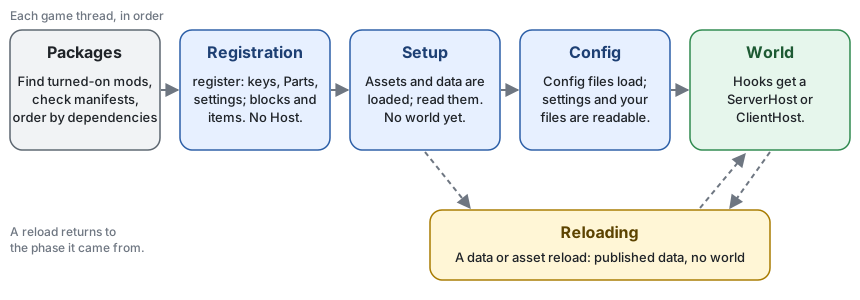
Native and wasm hooks share the installed dependency-ordered mod slice, including registration, config loading and reload-listener registration. The shared resolver keeps bundle-order ties, checks present optional dependencies too, and refuses cycles for both build targets. Content-only packages stay after code in the loaded-mod inventory; listener-specific edges use ReloadOrder.
Each owning thread progresses through Packages → Registration → Setup → Config → World.
| Phase | Available access |
|---|---|
| Packages | Package discovery; no game Host operations. |
| Registration | Declarations through RegistrationContext, with its mod-list, registry and settings reads; no Host. |
| Setup | Client setup reads, published asset/data queries and registry/settings/mod-list reads; no world handles or transactions. |
| Config | Settings reads and the mod-scoped ConfigFiles service; no world handles, transactions or other game operations. |
| Reloading | Published asset/data queries, registry facts, settings and mod-list reads, listener registration, and DataLoadContext callbacks; no world handles or transactions. |
| World | The owning game's side-typed ServerHost or ClientHost. |
RegistrationContext::instance_dir() reads the instance directory captured before registration begins, as an InstanceDirectory: Unix(Vec<u8>) preserves raw Unix path bytes, and Windows(Vec<u16>) preserves Windows UTF-16 code units, including unpaired surrogates. Never convert Unix bytes with a lossy UTF-8 conversion when constructing a native filesystem path. Wasm receives the identical host-encoded value through Wire as data only; this does not grant filesystem access. A context with no engine snapshot returns RegistrationReadError::Unavailable.
A mod that does slow work while the game starts shows it on the startup loading screen (NeoForge's StartupNotificationManager and ProgressMeter). RegistrationContext::progress(label, steps) opens a bar under the game's stage bar and returns Result<StartupProgress, StartupProgressError> (handle TooManyBars when 64 bars are already open): step(), set(n) and label(text) move it, and dropping it removes the bar. The mod may keep the handle past register and step it or call bar.message(text) from a worker thread or from client_setup. RegistrationContext::message(text) shows a line for a few seconds. The newest four bars and the last three lines are drawn, each cut to one line. A dedicated server logs each label, line and tenth of a bar's steps instead. A wasm mod holds the game's screen by id, and each call crosses to the game. A custom loading window is not part of this.
This is part of the startup progress feature, not live rendering of synchronous setup work. Bars can be opened through RegistrationContext; client_setup has no creation context and must retain a handle from registration. Updates become visible only while the loading screen is actually drawing. A synchronous client_setup listener runs on the render thread, so its updates cannot draw live and may appear only after it returns, if another loading frame is drawn. Slow work can run in a mod-owned worker and step a retained bar, but neither that worker nor the bar keeps the loading screen open. Live display of synchronous setup work and a creation route from client_setup remain outside this change.
Registration and setup
Registration runs once: register, component_types, blocks, items and standalone_models receive no Host and read startup facts through RegistrationContext. register also receives &mut dyn Registrar for writing declarations. The context's mods(), registry(name) and setting(mod_id, key) read one view captured before the first of them runs, so every registration step sees the same values whatever the dispatch order: the loaded packages, the built-in registries as registries.json lists them (not what mods declare during registration) and the settings on disk when the snapshot is captured. A mod validates the keys it declares against them from Hooks::register; a name that is not a namespaced identifier, an unknown registry, an empty or path-like setting key, a package that is not loaded, or a context the engine gave no data returns a RegistrationReadError. Client setup runs once after the initial asset apply. The window's Client/Common configs load once immediately after client setup and before title, connection, input, render or ordinary tick callbacks. This includes pack-error recovery: the failed selection is cleared and saved during initialization, but its options screen opens only after Config completes. A title-screen callback is already in World: world-handle constructors can return None, rather than being forbidden in Setup. A dedicated server loads Common once before its first world; Server configs load and unload per world. A second world does not repeat registration or client setup. Config loading can read settings and use the scoped ConfigFiles service to read or save its own config files. World handles, transactions and other game operations panic with Config in the diagnostic. Config file polling is not a phase transition, and Server config unloading leaves the World phase.
Attribute bounds are registration data too. Registrar::widen_attribute_bounds asks, from a both-side package's register, join the attribute catalog once when it grows: after the attributes mods declare with declare_attribute, and before entity attribute rows resolve and anything reads a definition. The bounds become the union of every mod's asks, so the result does not depend on the dispatch order, and the default never moves (content mods has the call, its refusals and what saves keep).
Reloading
Every data or asset reload enters Reloading, including listener registration, prepare, apply and the reload completion notice. Initial loads can nest in Setup; runtime reloads nest in World. Returning, including after a failed prepare, restores the entering phase. Published asset/data queries read the published generation, not pending prepare output: completion callbacks can refresh sprite and recipe caches after apply, including on first world open, without gaining world handles or transactions. Their rustdoc names their load-phase availability. Server listener registration retains &dyn Host, restricted to these published facts, registry facts, settings and mod-list queries. Callbacks that take DataLoadContext use its restricted reads. Neither permits opening a world handle or transaction. The first client registration and prepare run on the loader thread; later registration runs on the render thread, prepare on its worker, and apply on the owning game thread.
Load contexts
DataLoadContext and LoopContext expose frozen registry and settings metadata. Use DataLoadOrigin to identify the load origin and LoopSide to identify the owning side. Registry entries retain registry ID order on native and wasm.
In World, both client and server hosts expose registry_entry(registry, id), registry_entries(registry) and registry_entry_in_tag(&entry, tag). These read the current side's live registry and merged tags, not pending reload data. Unknown or unavailable registries and entries return None; an absent tag or a tag that does not contain the entry returns Some(false). Enumeration yields each identity once.
Server world-generation reads use the published decoded owners, including the live feature data in worlds without a terrain locator. Invalid source files do not establish entries. Prepared world-preset files have no published complete registry owner, so minecraft:worldgen/world_preset is unavailable; selecting a preset, sharing generator resources or reopening a saved stem does not change that.
RegistryEntry is a plain Wire value containing registry: Identifier and id: Identifier, identical on native and wasm. Its names may be retained across reloads; constructing the value does not establish that the entry exists. as_block_key(host), as_item_key(host) and the corresponding narrowing methods for block entity types, boolean game rules, dimensions, effects, enchantments, entity types, fluids, menus and particles resolve a real host-issued typed key. A different registry or unknown entry returns None. Typed keys remain process-local; narrowing never treats a protocol numeric ID as a key slot.
Mod-declared datapack registries resolve tags against the accepted candidate before publication; tags with missing required members are omitted. Synchronized snapshots carry those exact tag names and members (including empty tags); server-only and unnegotiated registries send neither entries nor tags. Clients validate membership before activating a snapshot. On clients, generic reads never fall back to prepared server-only datapack files: built-ins and the connection's currently synchronized registries are the entire view.
The game alone advances phases. An illegal or wrong-thread advance is refused before dispatch; a forbidden mod call panics naming the phase, rather than returning a Result. There is no separate common-setup, load-complete or intermod event: registration and the first server reload cover common setup, client setup is client_setup, dedicated setup is server_about_to_start, and dependencies express intermod ordering. Load complete is the edge after initial Config and before server_about_to_start, not a hook.
FML's file and path APIs (ModList file reads, config full paths, the game directory, update URLs) are replaced on purpose; FML loader APIs and their Sunrise routes lists each one.
Settings snapshot limits
Settings snapshots accept regular UTF-8 files only. File and package-directory symlinks, including internal links, are not followed. Invalid UTF-8, special files and refused entries are absent from the snapshot rather than reported as read errors.
| Limit | Behaviour |
|---|---|
| 64 KiB per file, before trimming | Oversized values are omitted. |
| 1,024 captured keys per mod | Additional keys are omitted. |
| 16 MiB for the snapshot, before trimming | Values exceeding the remaining budget are omitted. |
| 4,096 enumerated names per package | A package exceeding the budget is omitted entirely. |
Capture proceeds in sorted package-ID and key-name order. Missing settings directories and empty settings produce no warning. A capture with refusals emits one warning naming each known omitted key, its mod and its reason; an inaccessible or incompletely enumerated directory is identified by scope instead of inventing a key. Enumeration-limit diagnostics name the entries visited within the bounded scan; the entire package is still omitted. Initial registration, item-data loading, table preload and loop publication share one captured settings snapshot rather than rescanning it on each startup thread. The game, audio and world-generation readers retain that generation's immutable snapshot without recapturing or repeating diagnostics. A new capture reports new refusals, even if an earlier generation already warned. These limits apply to scalar settings, not mod data files.
Edit this page on GitHub · Spotted something wrong? Open an issue or ask on Discord.